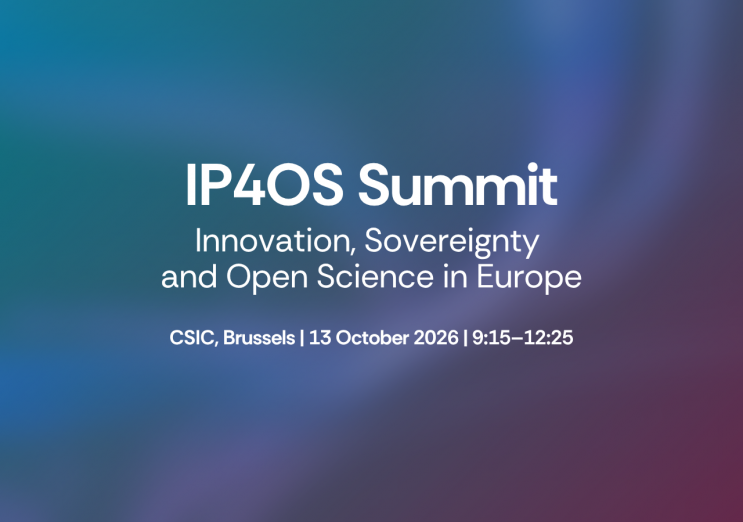
Save the date: 13 October 2026 | CSIC, Brussels | 9:15–12:25
The IP4OS project is hosting a high-level policy summit in Brussels, bringing together policymakers, researchers, legal experts, industry representatives, and open science actors to explore how intellectual property, open science, and AI-driven innovation can be better aligned to strengthen Europe's capacity to innovate.
The summit will tackle pressing questions at the heart of European competitiveness: Why does Europe produce excellent research but not consistently retain its value? Is there a real tension between open science and innovation — or can openness become a strategic asset? And what governance models can help bridge the gap between knowledge production and value creation?
Discussions will feed directly into key EU policy processes, including the European Innovation Act, the ERA Act, the Digital Omnibus on Data, and the future Framework Programme (FP10).
|
Time
|
Session
|
| 09:15 – 09:30 |
Welcome and Setting the Scene - Representative of CSIC, Prof. Dr. Julia Priess-Buchheit, Coordinator of the IP4OS Project, and a Representative of the European Commission (TBC)
|
| 09:30 – 09:50 |
Opening Keynote
Open Science as a Driver of European Innovation
Speaker: Prof. Jean-Claude Burgelman (TBC)
Key message
Europe already produces world-class research. The challenge is creating the conditions for that knowledge to generate scientific, societal and economic value while preserving the principles of Open Science. Responsible knowledge governance is not only a question of intellectual property, but also of institutional capacity, collaboration and trust.
|
| 09:50 – 10:45 |
Session I
High-Level Dialogue
Building Europe's Open Science Innovation Ecosystem
How can Europe strengthen knowledge valorisation while preserving the principles of Open Science? - This discussion, including current developments around securing data, brings together representatives from European institutions, research organisations, industry and civil society to reflect on the broader lessons emerging from the European innovation landscape. Consortium partners will bring into discussion Input from IP4OS Synergy Framework and White Paper
Discussion themes
- What are the main barriers to translating research into impact?
- How can Open Science and competitiveness reinforce one another?
- What role should universities, research organisations, funders, policy makers and industry play?
- How can Europe strengthen trusted collaboration across the innovation ecosystem?
- What capacities are needed to support responsible knowledge governance?
|
| 10:45 – 11:15 |
Networking Coffee Break
An extended networking break providing opportunities for researchers, policymakers, industry representatives and project partners to exchange ideas before the second part of the Summit.
|
| 11:15 – 12:15 |
Session II
IP4OS in Practice: Innovative Solutions for Responsible Knowledge Governance
From project results to institutional implementation
This session showcases the practical solutions developed through the IP4OS project and demonstrates how research organisations can strengthen responsible knowledge governance in practice.
Part I – Open Innovation Challenge Showcase (30 minutes)
University of Luxembourg
Presentation of the winning Open Innovation Challenge, highlighting the governance challenge addressed, the proposed solution and its potential for wider adoption.
The Hague University of Applied Sciences (THUAS)
Presentation of the winning Open Innovation Challenge, focusing on practical implementation, stakeholder collaboration and institutional impact.
Part II – Building Institutional Capacity (30 minutes)
Presentation of key IP4OS outcomes
- IP4OS Valorisation rubric
- FAIR-R2L Responsible Knowledge Governance Framework – Supporting responsible knowledge sharing and valorisation
- Multi-professional Teams – Bringing together legal, IP, Open Science, research management and data stewardship expertise to strengthen institutional decision-making
|
| 12:20 – 12:30 |
From practice to policy
The IP4OS Summit has demonstrated that Europe already possesses practical tools, governance models and institutional approaches capable of strengthening knowledge valorisation while preserving the principles of Open Science.
These experiences provide valuable evidence for the next stage of the discussion: how European policy can create the conditions for these approaches to scale across the European Research Area.
The conclusions emerging from the Summit will feed directly into the STOA Workshop at the European Parliament, where Members of the European Parliament, the European Commission and international experts will discuss the strategic implications for Europe's future framework on intellectual property, Open Science and AI.
|
|
|
The event will take place at CSIC Brussels (Rue du Trône 62, 1050 Ixelles) and is open to 80 in-person participants, with a further 70 places available online.
Register here.