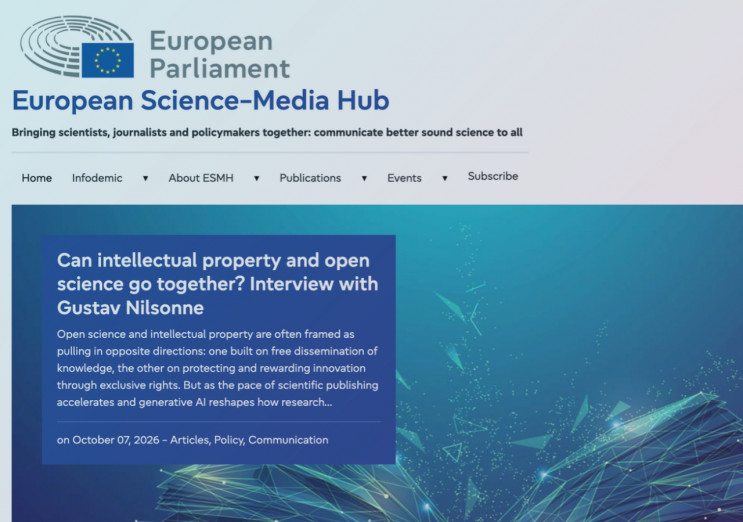
Why open science and intellectual property need each other? Interview with Gustav Nilsonne
Ahead of a STOA workshop in the European Parliament, the Karolinska Institutet researcher Gustav Nilsonne talks about paywalls, patents, unclear rules and AI.
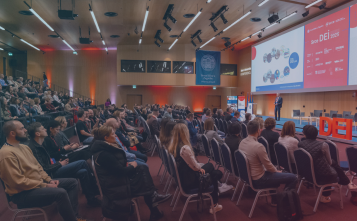
Open science and intellectual property are often seen as pulling in opposite directions. In a new interview with Science Media Hub, IP4OS work package leader Gustav Nilsonne argues that the two can work together, and that researchers need better support to make that happen. The interview comes ahead of the STOA workshop “Rethinking intellectual property in the era of open science and AI”, which takes place at the European Parliament on 13 October 2026. Nilsonne, associate professor of neuroscience at Karolinska Institutet and head of its metascience research team, is one of the speakers.
He starts by saying that much research is still not open, which he considers a failure of the research community. Many papers sit behind paywalls, and the data and code behind them are usually not shared. In his view, research is still published as though it were printed on paper, and the move to a digital, open system has not yet happened.
He then turns to why intellectual property matters to scientists. Society expects researchers to deliver innovations, and doing so means understanding how copyright applies to texts, datasets, images and code, and how to time a patent application before publishing. Universities, he says, need to support researchers here, because they cannot also be legal experts. He adds that the principle of “as open as possible, as closed as necessary” is hard to interpret, and that fear of doing something wrong leads many researchers to close their work more than they need to.
On AI, Nilsonne doubts that models should be able to hold copyright, since they are not legal subjects, and he believes a human must take responsibility for any output. He does not see the use of the scientific literature to train AI models as very problematic. Researchers write papers hoping they will be read and found valuable, and he benefits from AI tools himself.
These questions are at the core of IP4OS, the Horizon Europe project that is building a framework and best-practice guidance on how IP rights management can support open science.
Read the full interview: https://sciencemediahub.eu/article/2026/10/07/can-intellectual-property-and-open-science-go-together-interview-with-gustav-nilsonne